In a nutshell
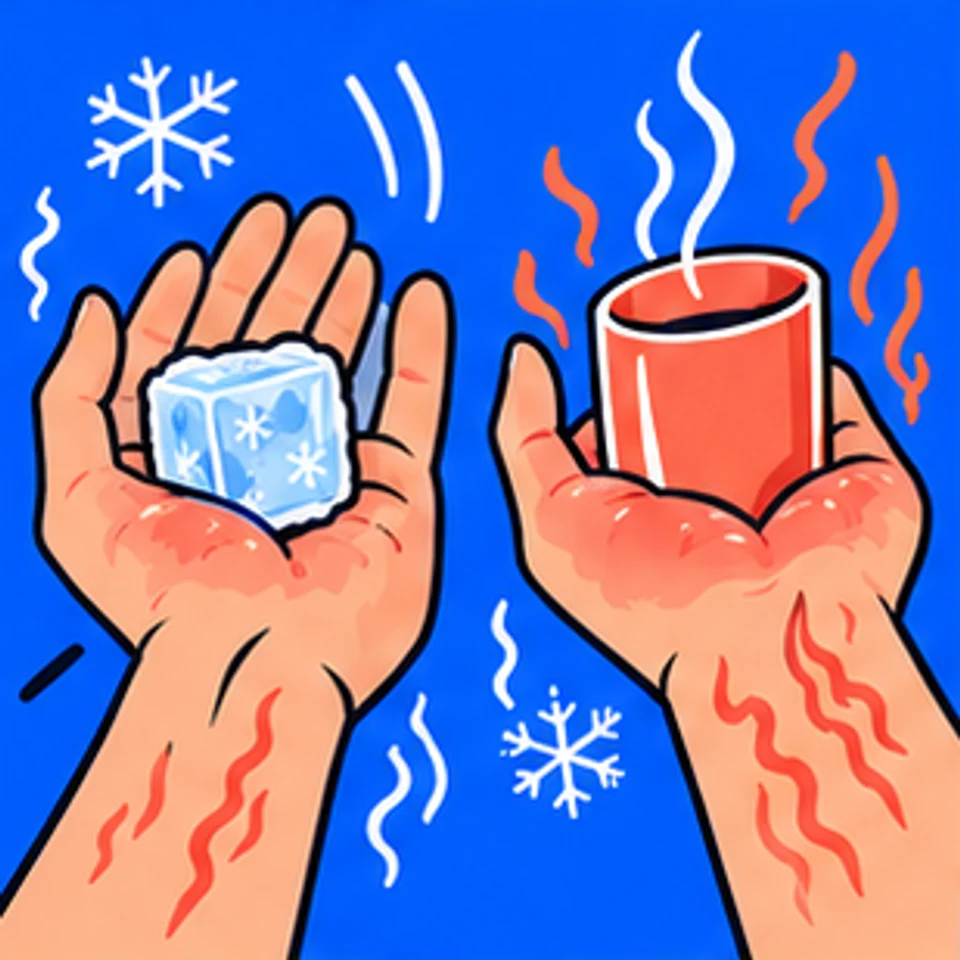
Alternating warm and cool contact surfaces can together feel surprisingly burning. Each individual surface can be within a temperature range that is not painful by itself.
Why does it happen?
Warmth, cold, and pain processing influence one another. The spatially interleaved stimulation creates signal relationships that can be interpreted as burning heat or pain. Different models explain this through altered inhibition and central integration; a fully unified mechanism is not established.
Frequency
The thermal grill illusion is chiefly known from controlled experiments. How strongly it is experienced depends on the temperature pattern and the person; no population rate exists for everyday experiences.
Frequency is a qualitative description, not your individual probability.
Is it normal?
Demonstrates an interaction between temperature and pain processing.
When to seek advice
Persistent burning without a corresponding stimulus is not this illusion and should be medically assessed.
Does this happen to you?
Your answer is first saved only on this device.
How others answer
Loading results …
No shared answers yet.
Voluntary responses, not representative. One answer per saved browser key and article is counted. Multiple submissions are possible; people are not verified.
Sources (1)
- A Review on Various Topics on the Thermal Grill Illusion (opens a new tab)
Interleaved mild warm and cold stimuli can produce burning or pain; several mechanistic models are discussed.
Editorial update: . AI-assisted research and editing; not individually reviewed by a physician. How we research